


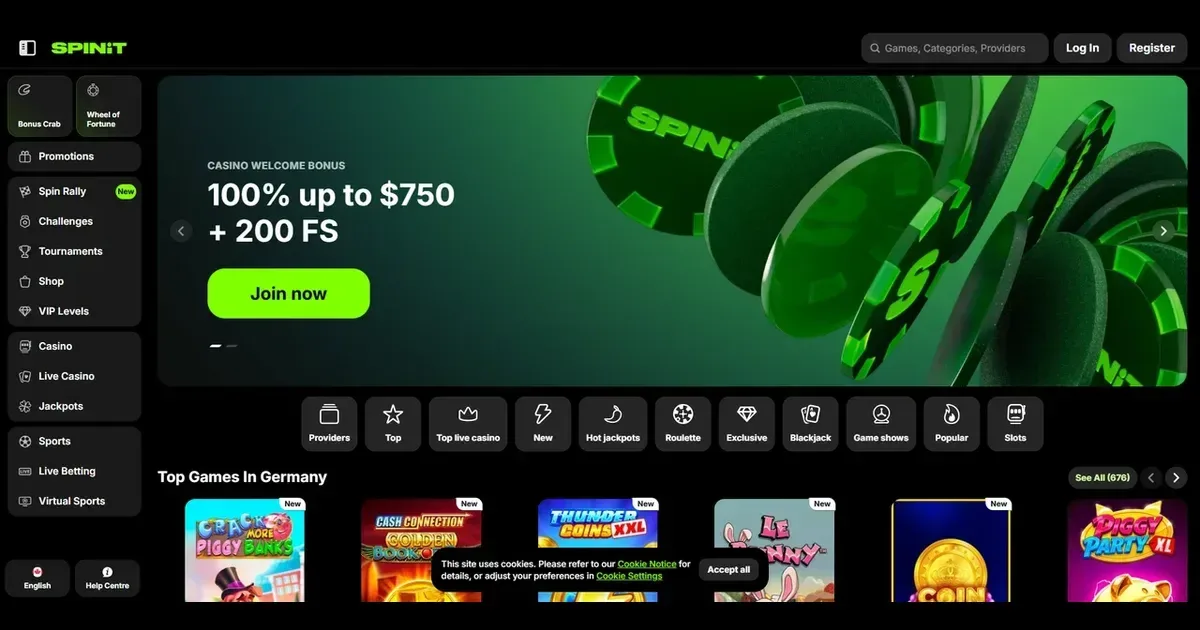
We want every session at Spinit to stay enjoyable. Gambling works as entertainment when you stay in control of how much you spend and how long you play — and we recognise that sometimes it stops being fun. This page explains the tools we offer, the warning signs worth watching for, and where to get help in the UK when you need it.
Why responsible gambling matters
Gambling is a choice, not an obligation. It should never feel like a way to solve money problems, and it should never take time or funds away from the things that matter to you. We run betting and casino games because they entertain people — but only when they stay that way.
The line between entertainment and harm is not always obvious while you are crossing it. That is why we build controls into every account, and why UK organisations exist specifically to help when things go wrong.
Signs gambling is getting out of hand
These behaviours suggest gambling has moved past entertainment into something more serious:
- Spending more than you planned, or chasing losses with additional deposits
- Borrowing money, using credit, or dipping into savings meant for bills
- Lying to family or friends about how much you gamble or how much you have lost
- Gambling when you are anxious, stressed or low as a way to feel better
- Neglecting work, relationships or responsibilities because of time spent gambling
- Feeling restless or irritable when you try to cut down or stop
If more than one of these applies to you, it is worth talking to someone. The support services below are free, confidential and run by people who understand what you are dealing with.
Questions worth asking yourself
A short self-check can help you see where you stand. Answer honestly:
- Do you gamble more often or for longer than you originally intended?
- Have you tried to cut back and found you could not?
- Do you hide your gambling activity from people close to you?
- Has gambling caused arguments or damaged a relationship?
- Have you missed work, cancelled plans, or borrowed money because of gambling?
- Do you gamble to escape problems or to feel better when you are down?
One "yes" does not mean you have a problem, but several of them suggest gambling is affecting your life in ways it should not. That is when reaching out makes sense.
Control tools we offer
We provide self-exclusion as the primary responsible gambling tool. If you need to take a break or stop altogether, email [email protected] and request exclusion. Once applied, the account is locked and cannot be reopened until the period you specified ends.
Self-exclusion is not reversible during its term. If you ask for three months, the account stays closed for three months — that is the point. Use it when you need a hard boundary that cannot be undone on impulse.
National help available in the UK
These organisations provide free, confidential support for gambling problems. You do not need to wait until things are serious — they are there for questions, advice, and treatment at any stage.
GamCare
National Gambling Helpline: 0808 8020 133 (free, 24 hours a day, 7 days a week). GamCare also offers online chat, forums and face-to-face counselling across the UK. Visit gamcare.org.uk to find a counsellor near you or to access their NetLine live chat service.
BeGambleAware
BeGambleAware funds treatment services and provides information on safer gambling. Their site explains what help is available, how to access it, and what to expect. Visit begambleaware.org.
GamStop
GamStop is a free national self-exclusion scheme covering all UK-licensed gambling sites. Register at gamstop.co.uk and choose a period of 6 months, 1 year, or 5 years. Once active, you will be blocked from every licensed operator, not just one site.
Gordon Moody
Gordon Moody runs residential treatment programmes and online therapy for people with serious gambling problems. Their services are free and include one-to-one support and group sessions. Visit gordonmoody.org.uk or call 01384 241292.
Blocking software
Gamban (gamban.com) blocks access to gambling sites and apps across all your devices. It costs a small monthly fee and cannot be easily bypassed once installed.
BetBlocker (betblocker.org) is free, open-source software that works on desktops, phones and tablets. It blocks thousands of gambling sites and is supported by GambleAware.
Practical limits that work
If you want to keep gambling occasional rather than let it grow, these boundaries help:
- Decide a monthly amount you can afford to lose before you start, and stop when you reach it
- Set a timer and walk away when it goes off — long sessions blur decision-making
- Never gamble with money meant for rent, bills, or food
- Avoid gambling when you are upset, stressed or drinking — those states skew judgment
- Take regular breaks — a week off every month lets you check whether you can stop comfortably
Limits only work if you enforce them yourself. If you set a boundary and repeatedly ignore it, that is a sign the control is slipping.
Protecting minors
Access to this site is restricted to persons aged 18 and over (18+). If you share a device with someone younger, use parental control software such as Net Nanny (netnanny.com) or Qustodio (qustodio.com) to block gambling sites at the system level.
For free confidential support with gambling, contact BeGambleAware.org or call the National Gambling Helpline on 0808 8020 133.
Access to this site is restricted to persons aged 18 and over (18+). If gambling ever stops feeling like entertainment, free and confidential help is available at BeGambleAware.org.